

Our Curriculum: Putting the Individual First
Equipping learners with social, emotional and educational skills to live fulfilled lives at home, at work, and within the community.
At Ian Mikardo High School (IMHS), we put the individual at the heart of everything we do. Where mainstream educational structures may have felt alienating, our curriculum is 'Needs-Based, Skills Focused, and Learner Centred'.
Rooted in Bronfenbrenner’s Bio-ecological Model of Child Development, we recognise that a student's growth is shaped by their environment and relationships. We venture beyond conventional classroom boundaries—balancing formal learning with practical, creative experiences—to prepare our students to live healthy, happy, and fulfilled lives.
Three Core Pillar Areas
Our curriculum is structured across three core areas, designed to nurture analytical, social, and practical skills while opening doors to formal qualifications:
-
My Foundation: Developing essential real-world literacy, numeracy, and digital fluency (English, Maths, and IT).
-
My Being: Fostering personal health, emotional wellbeing, physical education, and interpersonal growth (PE, PSHE, Self-Care).
-
Our World: Exploring the environment, society, culture, and expression (Humanities, Science, Art, Media, and Music).
These areas are never isolated; area leaders collaborate to create integrated, project-based learning. Supported by low student-to-staff ratios and dedicated 1-to-1 assistance, our intensive support builds the trust and confidence essential for long-term success.
How Learning Progresses
Key Stage 3: Thematic & Project-Based Learning
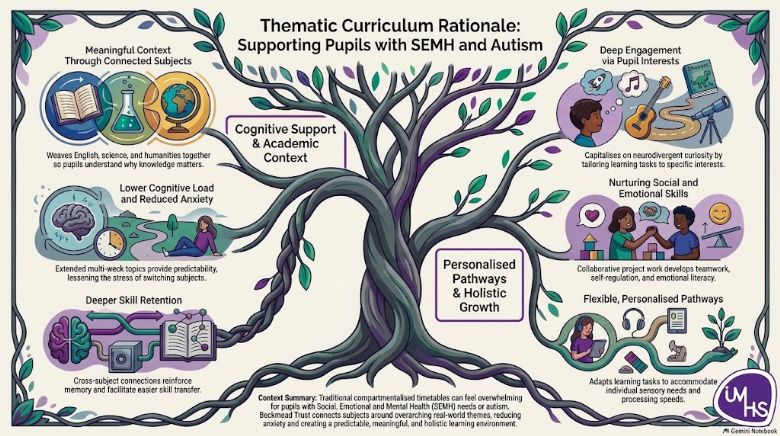
In Key Stage 3 (Years 7–9), students engage through overarching cross-curricular themes and a termly Skills Focus. Rather than studying subjects in silos, students explore unifying real-world topics. This thematic approach connects abstract concepts to daily life, fostering transferable social and academic skills within a collaborative environment.
Key Stage 4 & Post-16: Diverse Qualification Pathways
As students move into Key Stage 4 (Years 10–11) and Post-16, learning transitions into personalised, accredited pathways matched to individual strengths and future aspirations:
-
Academic & Core Qualifications: Entry Level Certificates (OCR) and Functional Skills (Edexcel) in English, Maths, and ICT, alongside GCSE pathways in core subjects for eligible learners.
-
Vocational & Practical Awards: Applied qualifications including BTEC Home Cooking Skills, Hair & Beauty, NCFE Music Technology, and Technical Art & Design awards.
-
Personal Development & Leadership: Accredited growth through the Get RIPPED psychosocial programme (NCFE Level 1), Sports Leadership, and the Duke of Edinburgh’s Award.
-
College Links & Work-Readiness: Post-16 link programmes with local FE colleges for hands-on vocational training (e.g. Construction, Motor Vehicle, Catering), combined with work experience and independent living skills.
Careers Programme
Preparing our students for working life is integral to our curriculum. From the moment they join our school, our careers leader, Karen Raftery, gets to know each student’s strengths and interests. We tailor learning and activities to the individual. We seek to inspire our students, unearth vocations, and equip them with the transferable skills necessary for realising their interests in the working world.
By embedding our careers programme in our curriculum, we ensure that careers are not thought of as some distant future separate to one’s education. All staff play an active part in preparing students to live as confident, independent adults. Over the years, we have cultivated links with a diverse range of employers. These connections provide our students with invaluable opportunities to develop skills, spark interest, and contribute to the wider community.
An overview
Our multifaceted careers programme includes:
- The application of academic skills to real life contexts
- A plethora of vocational qualifications
- A regular programme of talks given by people of industry, designed to inspire and open up a world of possibilities
- Enriching trips to workplaces within the local and wider community, including opportunities to ‘have a go’ for themselves
- Work placements and organised courses that provide valuable experience and the chance to learn new skills
- A carefully designed series of workshops dedicated to preparing students for working life
- Enterprise schemes driven by the students, building confidence in entrepreneurialism and showcasing their creative skills
All students will:
- Develop a deeper understanding of themselves, their potential and their passion
- Gain a greater knowledge of the wealth of opportunities open to them
- Understand the labour market and the requirements and expectations of employers
- Improve their employability, gaining confidence in soft skills alongside practical skills
- Learn to prioritise their future, be prepared to weather change, and be supported through key transition periods.
Year by Year Overview
Year 7 – New Beginnings
Helping students learn about themselves, their interests and their strengths is an important part of supporting them in their transition from primary to secondary school. During this year, they complete a self-assessment and self-development journal mapping the development of their skills. We also introduce crucial concepts and terminology to do with the workplace at this early stage, including discussions and lessons about tax, wage slips, and the cost of living.
Year 8 – Exploring the Workplace
At this stage, we introduce students to the mechanics of the workplace. In their exploration of the world of work, they gain an understanding of employers’ expectations and the labour market, as well as beginning to build the key and soft skills needed for employment.
Year 9 – Unearthing Vocations
In order to help students discover what types of work inspire them, we have a rich and diverse programme of courses, workshops, and visits to careers fairs to present them with a multitude of career options. Whether it be a life course run by the London Fire Brigade or a course in coding, by drawing on our many connections to people in industry, we ensure that students have every opportunity to discover their vocation.
Year 10 – Mastering Applications
During the course of this year, students participate in a programme carefully designed to help them apply to their place or position of choice, whether that be a job, placement or college. Each will learn how to write a personal statement, a CV, and a cover letter, as well as be coached in interview technique. These practical skills will equip students to secure work placements that they will undertake in sixth form.
Year 11 – Preparation for Progression
This year we will concentrate on supporting students in making vital decisions about their future. Through a programme of education, information and one-on-one guidance, we help each seriously consider and explore their options. We present them with a range of opportunities for further learning and qualification, including sixth form, FE College, apprenticeships and school-leaver programmes. By connecting with each individual, taking into account their strengths and interests, we support them in effective decision-making and plans for their future.
Year 12 – Gaining Work Experience
Students attend a work placement in their chosen field 1–2 days a week for the duration of the academic year. These placements help them to work towards a BTEC Vocational Qualification, allowing them to create a portfolio of evidence for individual units.
Year 13 – Finding Focus
In their final year at IMHS, we aim to set students firmly on their future paths. Each attends a course 3 days a week, selected on the basis of their chosen vocation. On the 2 other days of the school week, their learning and activities are geared towards developing the core and soft skills necessary for their chosen career.
SEN Support
We are a special school for young people with learning difficulties and social, emotional and mental health issues. IMHS’s provision for special needs is comprehensive. Our practice is trauma informed; knowing and understanding our students’ backgrounds is an important first step in supporting their emotional welfare and their education.
We have a dedicated specialist in communication and interaction whose expertise includes working with those with autistic disorders, Asperger’s Syndrome, and speech and language difficulties. We provide support for students with cognition and learning difficulties such as dyslexia and dyspraxia.
Building a relationship with parents and carers is crucial to helping our students progress. We have a range of strategies designed to cultivate these relationships and to ensure an individual’s education is supported outside of school. We also take an active interest in the welfare of students’ parents, and have a dedicated Welfare and Family Support Practitioner who lends a helping hand and understanding where needed.

Ian Mikardo High School
Address
60 William Guy Gardens, London E3 3LF