

Our Ethos & Core Values
At Ian Mikardo High School, our ethos revolves around mutual respect, empathy, inclusion, tolerance, and compassion. We believe that treating students as individuals and providing comprehensive, multi-disciplinary support empowers every young person to fulfil their academic and personal potential.
As part of The Beckmead Trust, Ian Mikardo High School shares the vision of the Trust while providing specialist trauma-informed education for 11–19 students with Social, Emotional, and Mental Health (SEMH) needs in the London Borough of Tower Hamlets.
In alignment with The Beckmead Trust, the school embeds the Trust's overarching ethos of "Nurture – Sustain – Grow" across every dimension of its practice, weaving these principles into daily routines, therapeutic interventions, and academic support.
Innovative, Inclusive & Future-Ready Learning
At Ian Mikardo High School, we are developing an innovative, inclusive and adaptable learning environment that places each young person's individual interests, strengths and aspirations at the heart of their educational journey. Through creative exploration, artificial intelligence, emerging technologies and personalised learning experiences, we provide meaningful opportunities that encourage engagement, build confidence and nurture independence. Rooted in our trauma-informed and relational ethos, this forward-thinking approach removes barriers to learning, celebrates individuality and equips young people with the skills, curiosity, creativity and resilience needed to thrive in an ever-changing digital world.

Our core vision is simple yet transformative: "Come with a past, leave with a future."
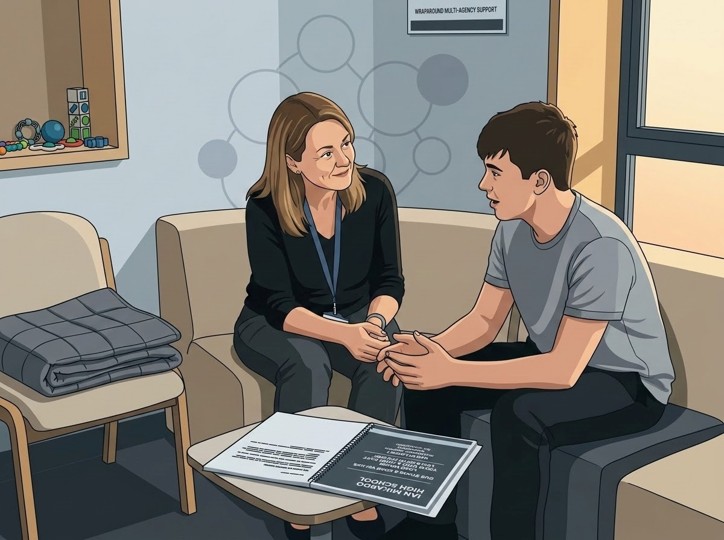
We offer a tailored combination of education and holistic care focused on three key areas:
-
Emotional Wellbeing & Therapeutic Growth: Prioritising mental health, emotional literacy, and co-regulation.
-
Academic & Vocational Achievement: High expectations delivered through a flexible, engaging, and creative curriculum.
-
Personal Growth & Independence: Building self-reliance, positive communication skills, and social responsibility.
School Aims
Our vision is supported by a practical, pragmatic, and trauma-informed approach to education. In close partnership with pupils, families, local authorities, and specialist providers, we achieve our vision through the following school aims:
-
Accurate Baseline & Ongoing Assessment: Accurately assessing learning abilities, literacy, numeracy, and SEMH needs upon admission and throughout each student's journey.
-
Personalised Learning Pathways: Identifying an individual educational and therapeutic pathway tailored to each student's Education, Health and Care Plan (EHCP) targets.
-
High-Quality Teaching: Providing high standards of teaching through structured classroom activities and a rich social curriculum.
-
Emotional Regulation & Resilience: Equipping students with self-regulation strategies, emotional literacy, and coping skills using relational tools.
-
Progress & Attainment: Ensuring all pupils make expected or better progress across academic, vocational, and personal pathways.
-
Post-16 -19 Destinations: Securing meaningful post-16 -19 education, training, or employment placements for all students.
-
Spiritual, Moral, Social & Cultural (SMSC) Development: Supporting wider SMSC needs while actively embedding fundamental British values, equality, and inclusion.
Our Relational Model & Behaviour Support Strategy (NVR)
At Ian Mikardo High School, student behaviour is recognised as a form of communication rather than an action to be met with traditional punitive discipline. We operate a whole-school Relational Model centred on Non-Violent Resistance (NVR) and trauma-informed practice.

-
Non-Violent Resistance (NVR): NVR is our core behaviour support strategy, prioritising "connection before correction," de-escalation, presence, low-arousal responses, and consistent adult support.
-
Individual NVR Safety Plans: Every student has a personalised NVR Safety Plan detailing individual triggers, early signs of dysregulation, preventative strategies, co-regulation methods, and reintegration steps.
-
Restorative Practice & Conflict Resolution: We engage students in reflective dialogue and conflict resolution to build empathy, self-awareness, and personal accountability.
-
Warm, Clear Boundaries: Staff engage students with warmth, positivity, and clear expectations, establishing high standards through respectful, trusting relationships.
Our Relational Model, Informed by NVR and Attachment Practice
|
Pillar |
Core Principle |
Operational Practice |
|---|---|---|
|
1. Presence & Connection |
Connection before correction |
Unconditional positive regard, active listening, and persistent adult presence during dysregulation. |
|
2. De-escalation |
Low-arousal interactions |
Reducing verbal load, managing tone and body language, and providing safe regulation spaces. |
|
3. Co-regulation |
Shared emotional processing |
Adult-led calm support, helping pupils transition from heightened emotional states back to baseline learning readiness. |
|
4. Restorative Practice |
Reflective accountability |
Structured restorative conversations post-incident to repair relationships, learn coping mechanisms, and restore community trust. |
What Makes Ian Mikardo High School Unique
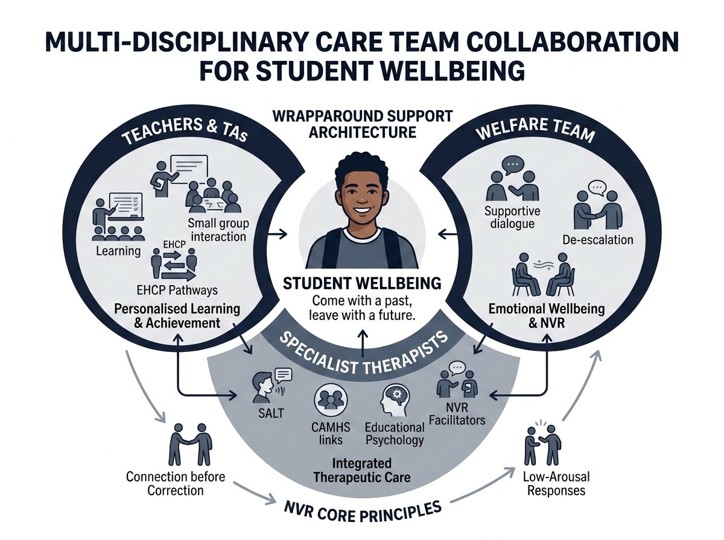
What makes Ian Mikardo High School unique is our relational, therapeutic ethos combined with a multi-agency approach to nurturing vulnerable young people. The school functions across three core aspects:
-
Specialist SEMH School Provision: Delivering high-quality education in an environment designed to remove barriers to learning and address complex emotional needs.
-
Integrated Welfare & Therapeutic Care: On-site welfare teams, CAMHS links, Speech and Language Therapy (SALT), educational psychology, and NVR facilitators providing wraparound support.
-
Family & Multi-Agency Collaboration: Working closely with parents, carers, social care, and local community partners to ensure consistent support both in and beyond school.
Wraparound Multi-Agency Support Architecture
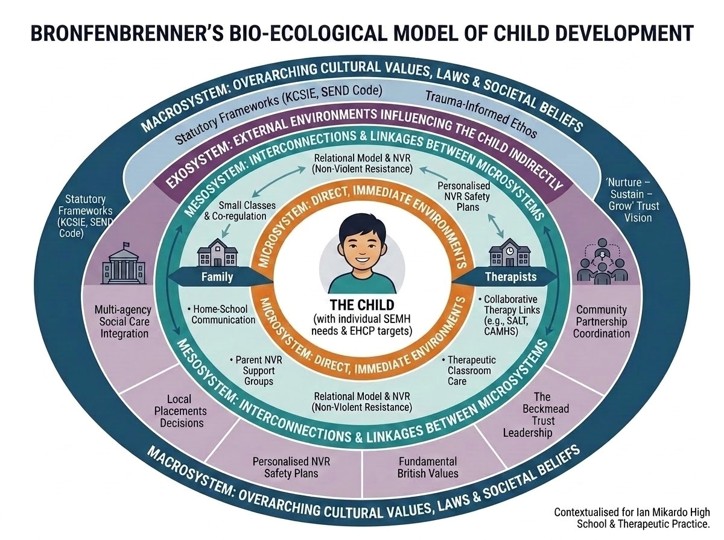
Bio-ecological Alignment: Bronfenbrenner’s Systems Framework
To ensure a comprehensive and systemic approach to child development, Ian Mikardo High School maps its ethos, relational practices, and multi-agency architecture across Bronfenbrenner’s Bio-ecological Model:
|
Ecological System |
Systemic Focus |
Mapped School Practices & Structures |
|---|---|---|
|
Microsystem |
Direct, immediate environments and daily face-to-face interactions. |
Relational Model & NVR in practice, small class ratios, co-regulation, low-arousal interactions, personalised NVR Safety Plans, and classroom-level therapeutic care. |
|
Mesosystem |
Interconnections and linkages between immediate settings. |
Collaborative links between school, family, and therapeutic teams (e.g., SALT, CAMHS links, parent NVR support groups, home-school communication). |
|
Exosystem |
External environments influencing the student indirectly. |
Multi-agency social care integration, local authority placement decisions, Beckmead Trust leadership, and community partnership coordination. |
|
Macrosystem |
Overarching cultural values, legal frameworks, and societal beliefs. |
Statutory frameworks (KCSIE, SEND Code of Practice, PSED), fundamental British values, trauma-informed ethos, and the Trust vision ("Nurture – Sustain – Grow"). |
|
Agency / Pillar |
Focus Area |
Key Delivery Mechanisms |
|---|---|---|
|
School & Education |
Tailored SEMH Learning |
Individualised EHCP pathways, small class ratios, and vocational development. |
|
Therapeutic & Welfare |
Integrated Care |
Speech & Language Therapy (SALT), CAMHS links, Educational Psychology, NVR practice. |
|
Family & Community |
Holistic Continuity |
Home-school partnership, parent NVR support groups, multi-agency social care integration. |
Governance & Statutory Alignment
Ian Mikardo High School operates under the leadership of The Beckmead Trust Board and Local Governing Body. Our policies and practices align with all relevant statutory frameworks:
Our robust safeguarding policies and procedures ensure that we fully meet our statutory duties under Keeping Children Safe in Education to protect and promote the welfare of every student.
-
DfE Statutory Guidance (Keeping Children Safe in Education, Working Together to Safeguard Children, Behaviour in Schools).
-
The Special Educational Needs and Disability (SEND) Code of Practice (0–25).
-
Equality Act 2010 and the Public Sector Equality Duty (PSED).

Ian Mikardo High School
Address
60 William Guy Gardens, London E3 3LF